
Recent Post
Archive
- August 2026
- July 2026
- March 2022
- January 2022
- November 2021
Tags
Custom Menu

Staircase Chandelier Guide: Sizing, Drop and Placement Tips
Lumin Lamp House
A staircase chandelier has one job that a regular ceiling light never has to think about: filling a tall, vertical space without hanging too low over the stairs or getting lost near a distant ceiling. Get the drop length right and everything else, style, bulb count, finish, falls into place. Get it wrong and you either bump your head on the way up or end up with a fixture that looks like an afterthought floating near the roofline. Here is how to measure your stairwell, decide where the chandelier should hang, compare styles, and plan the installation without surprises.
What makes staircase chandeliers different (drop length is everything)
Most ceiling lights are sized by diameter for a single-story room. A staircase chandelier is sized by drop, the vertical distance from the ceiling to the lowest point of the fixture, because it has to work across two stories of open space at once. A fixture that looks proportional from the foyer floor also has to clear head height for anyone walking up the stairs and still read as intentional when viewed from the second-floor landing.
This is why staircase chandeliers are typically sold with adjustable or extendable cabling, often in the 6 to 12 foot range beyond the standard chain, rather than a fixed drop. You're picking clearance for three different sightlines at once: the entry floor, the stair treads, and the upstairs hallway.
How to measure your stairwell: ceiling height, drop and sightlines
Before you shop, take four measurements: overall ceiling height from the entry floor, the height of the ceiling above the stair midpoint, the width of the stairwell opening, and the distance from the fixture's mounting point to the nearest stair tread below it. Here are the rules of thumb we give customers planning a two-story foyer:
- Total drop for a typical two-story foyer (13 to 20 ft ceilings): plan on the chandelier filling roughly half to two-thirds of the vertical space, so a drop of 5 to 12 feet is common.
- Minimum clearance over walking areas: keep at least 7 feet between the floor or stair tread and the lowest point of the fixture, including any hanging crystals or finials.
- Sightline over the stairs: if the chandelier hangs over the stairwell itself, the lowest point should sit at or above the second-floor railing line, so it never appears to hover below eye level as someone reaches the top step.
- Width rule: a chandelier hung in an open stairwell should generally span no more than one-third to one-half of the well's width, so it does not crowd the railing on either side.
If your ceiling height falls outside the 13 to 20 foot range, scale the drop proportionally. A 10-foot single-story entry with a partial two-story cutout needs a much shorter drop, often 3 to 5 feet, while a great room with a 24-foot peak can handle a longer, more dramatic hang.
Placement options: over the stairs, in the well, or at the landing
There are three common places to hang a staircase chandelier, and each changes the clearance math slightly.
- Directly over the stairs: the most dramatic option, but it demands the strictest attention to the 7-foot clearance rule and the second-floor sightline, since people walk directly underneath it on the way up.
- In the open stairwell, away from the treads: a good middle ground. The fixture hangs in the vertical shaft but not over the steps themselves, so clearance is less critical and the drop can be longer without feeling low.
- At the landing or upper hallway: works well for shorter stairwells or when the entry ceiling is not tall enough to justify a full two-story piece. The chandelier reads as a landing feature rather than a foyer centerpiece.
Whichever placement you choose, view the spot from the front door, from partway up the stairs, and from the second-floor railing before finalizing the order. A fixture that looks perfect from the entry can still block a sightline from upstairs.
Styles compared: spiral, linear, crystal and rotating
Once drop and placement are settled, style is mostly about how the fixture reads from multiple floors at once.
- Spiral or tiered chandeliers: multiple tiers of lights wind down the drop, giving visual interest at every level of the stairwell. These work well when the chandelier is viewed from several angles as people move up and down.
- Linear chandeliers: a single continuous column of light, often minimalist or industrial in style. Good for narrow stairwells where a wide spiral would crowd the railing.
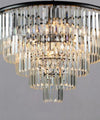
- Crystal chandeliers: classic for formal or traditional foyers, with strands or tiers of crystal that catch light from the entry and from above. These tend to have more visual weight, so double-check the width rule against your stairwell.
- Rotating chandeliers: a motorized version that slowly turns on its axis, useful when the fixture needs to look finished from every side because it is visible from stair landings on more than one level. If that fits your space, our rotating staircase chandelier is built for exactly this kind of multi-angle viewing.
None of these styles is inherently better. The right one depends on whether your stairwell is viewed mostly from one angle (entry looking up) or from several (entry, stairs, and upper hallway all at once).
Shop staircase chandeliers from our collection
A few pieces from our own catalog that follow the sizing and placement rules above, each available in multiple drop lengths:

Staircase Rotating Chandelier from $182.40

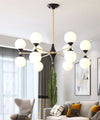
Yoogee Staircase Chandelier from $109.39

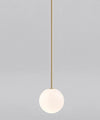
Glass Ball Staircase Chandelier from $195.84
Installation and cleaning at height: what to plan for
Long chandeliers almost always ship in sections, a canopy, a center rod or chain assembly, and the light fixture itself, so plan for an afternoon of assembly rather than a quick hang. Because of the weight, the height, and the electrical work involved, we recommend hiring a licensed electrician for installation rather than attempting a DIY hang on a ladder over an open stairwell. This is not a place to cut corners on safety.
Cleaning is the other honest conversation worth having before you buy. Fixtures hung 10 to 20 feet up are hard to reach with a standard duster. For moderate heights, an extendable dusting wand handles most upkeep between deeper cleanings. For very tall wells, especially anything over 20 feet, expect to need scaffolding or a lift every year or two for a thorough clean, particularly with crystal styles that show dust more visibly than metal or glass. Factor that maintenance into your decision alongside the upfront look.
FAQ
How long should a staircase chandelier be?
Most two-story foyers with 13 to 20 foot ceilings look best with a drop of 5 to 12 feet, filling roughly half to two-thirds of the vertical space. Always keep at least 7 feet of clearance over any walking surface below.
How do you clean a stairwell chandelier?
For moderate heights, an extendable dusting wand handles routine dust every few weeks. For very tall wells or heavily tiered crystal styles, plan on scaffolding or a lift for a deeper clean once a year or two, and always cut power before touching any wiring or bulbs.
What is the best lighting for a two-story staircase?
A single well-proportioned chandelier sized to the drop rules above is usually enough, but pairing it with wall sconces along the stairwell adds light at tread level and reduces shadows on the steps, which is both safer and more flattering than relying on the chandelier alone.
If you are ready to start narrowing down options, browse our chandelier collection for styles in a range of drop lengths and finishes. Every order ships free within the US, and if you are not sure your measurements are right, reach out before you buy, we are happy to double-check drop and clearance with you.
← Older Post Newer Post →