
Recent Post
Archive
- August 2026
- July 2026
- March 2022
- January 2022
- November 2021
Tags
Custom Menu

Bubble Chandeliers: Styles, Sizing & How to Style Them
Lumin Lamp House
A bubble chandelier is one of those fixtures that photographs well and lives well, which is rare. Round glass globes catch light instead of blocking it, so the piece reads as sculptural without going heavy over a table or a seating area. If you are trying to figure out which layout, size and finish actually fits your room, here is what matters.
The short answer
Pick branching for statement living spaces, linear for rectangular tables and islands, cluster for entries and bedrooms. Size the fixture at one half to two thirds of the table length, and hang the lowest globe 30 to 36 inches above the tabletop. That covers most rooms without overthinking it.
What is a bubble chandelier (and why it never left)
A bubble chandelier is a fixture built from multiple glass globes, either mounted on branching metal arms or hung at staggered lengths from a single canopy. The look traces back to 1960s mid century design, when designers started pairing exposed bulbs with clear or lightly tinted glass spheres instead of shades or crystal drops.
The reason it still shows up in new builds and renovations is simple: it is sculptural without being bulky. Because the globes are mostly glass and air, the fixture does not visually crowd a room the way a solid drum shade or a dense crystal chandelier can. That makes it flexible. A branching bubble chandelier holds its own in a contemporary living room, a linear version disappears nicely over a farmhouse table, and a cluster of globes can soften an otherwise minimalist bedroom. Few fixture types cross that many style lines this easily.
Branching, linear or cluster: which bubble chandelier fits your room
Bubble chandeliers generally fall into three layouts, and each one solves a different room problem.
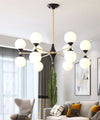
- Branching: globes sit at the ends of metal arms radiating from a central point, similar to a sputnik fixture. This is the statement option, best for living rooms, dens or a foyer with some open air around it. It needs breathing room, so give it at least 3 feet of clearance from walls and tall furniture in every direction, or the arms start to feel cramped.
- Linear: globes are arranged in a straight row along a bar or rod. This layout was built for rectangular dining tables and kitchen islands, since the shape naturally follows a long surface without overhanging the edges.
- Cluster: globes hang at staggered heights from one canopy, sometimes on individual cords. This is the most forgiving layout for entries, bedrooms and round or square tables, since the irregular heights fill vertical space without needing a wide footprint.
One more note on cluster styles: in a stairwell or a double-height entry, a cascading cluster of globes at different lengths can look genuinely striking, since the varied heights read well from multiple floors. Measuring and sizing for those tall, open spaces is its own topic though, so if that is your project, use our staircase chandelier guide for stairwells and our two-story foyer chandelier guide for two-story entries. Both walk through the measuring and drop-length formulas those spaces need.
Sizing a bubble chandelier over tables and islands
Getting the size right is mostly arithmetic, not taste. Here are the numbers that hold up in most dining rooms and kitchens:
- Fixture length: aim for one half to two thirds of the table or island length. A 72 inch table works well with a fixture between 36 and 48 inches long.
- Hanging height: the lowest globe should sit 30 to 36 inches above the tabletop or countertop. That range keeps light at eye level without anyone ducking to see across the table.
- Open area clearance: if the fixture hangs over a walkway or open floor space rather than a table, keep at least 7 feet of clearance between the floor and the lowest globe.
- Globe count: for a small dining nook or breakfast table, 3 to 6 globes is usually enough. Standard dining tables look balanced with 6 to 10 globes. Anything above 10 starts to read as a large statement piece, better suited to bigger rooms or higher ceilings.
A quick reference, since these numbers are easy to mix up:
| Space | Fixture length | Globe count |
|---|---|---|
| Small table or nook | 24 to 36 inches | 3 to 6 globes |
| Standard dining table | 36 to 48 inches | 6 to 10 globes |
| Large table or statement room | 48 inches and up | 10 or more globes |
For kitchen islands, treat the countertop like a table: measure its length, apply the same one half to two thirds rule, and keep the lowest globe 30 to 36 inches above the counter surface, not the floor.
Shop bubble chandeliers from our collection
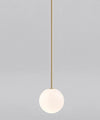
Two pieces from our own catalog that show how different the same idea can look:

CONCISE Brass Bubble Chandelier from $550.54

Nordic Glass Ball Bubble Chandelier from $475.78
Finishes and glass: getting the mix right
The frame finish and the glass tone do most of the visual work here, so it is worth choosing both on purpose rather than picking whatever looks good in a listing photo.
For frame finish: black reads as strong contrast against light ceilings and pairs easily with contemporary or industrial rooms. Brass and gold bring warmth and work well in transitional or boho spaces, especially with wood furniture. Chrome and brushed nickel lean cooler and modern, and tend to match stainless appliances or glass and steel decor. As a general rule, match the chandelier finish to your existing door hardware, faucet or cabinet pulls so the metals in the room do not compete.
For glass: clear glass shows the bulb and filament, which gives the most sparkle and the airiest look, but it also means the bulb itself is on display, so a decorative filament bulb is worth the extra few dollars. Smoked or amber glass diffuses more light, softens glare, and creates a moodier look, which suits a dining room used mostly in the evening. If you are not sure which to pick, ask yourself how much bulb you actually want visible. More visibility means clear, less means smoked or amber.
Keeping the globes clean (it is easier than it looks)
Glass globes collect dust faster than shaded fixtures simply because there is more exposed surface, but the upkeep is not complicated.
- Dust the globes monthly with a microfiber duster or a soft, dry cloth. This alone handles most of the buildup.
- Twice a year, if the globes are removable, take them down and wash them in warm water with a mild dish soap, then dry completely before reattaching.
- Never spray glass cleaner directly at the fixture. Overspray can reach the wiring or socket and cause problems that are not worth the shortcut. Spray a cloth instead, then wipe.
- Check clear glass globes in daylight, not lamp light, since water spots and fingerprints show up far more clearly in natural light.
FAQ
Are bubble chandeliers still in style?
Yes. The mid century roots give it a proven shape, but the open, airy structure works just as well in current contemporary, transitional and boho interiors. It has stayed relevant longer than most trend-driven fixture styles because it never relied on one specific decor trend to look right.
How low should a bubble chandelier hang over a dining table?
Hang the lowest globe 30 to 36 inches above the tabletop. That range keeps the light at a comfortable eye level for people seated at the table and avoids the fixture blocking sightlines across the room, regardless of table shape or size.
How do you clean a bubble chandelier?
Dust monthly with a microfiber duster, and wash removable globes in warm soapy water about twice a year. Avoid spraying cleaner directly at the fixture since it can reach wiring. Check clear glass in daylight to spot water marks you might miss under artificial light.
If you have a size, finish or glass tone in mind, browse our chandelier collection to compare options side by side. And if you are not sure your measurements are right before you order, reach out, we are glad to double check them with you, and every order ships free within the US.
← Older Post Newer Post →