
Recent Post
Archive
- August 2026
- July 2026
- March 2022
- January 2022
- November 2021
Tags
Custom Menu

Mid Century Modern Lighting: A Buyer's Guide
Lumin Lamp House
Mid century modern lighting is one of those styles that never really left, it just keeps getting reinterpreted for new homes. The shapes from the 1950s and 60s, organic curves, radiating arms, warm metal and glass, still look sharp today because they were built on proportion and material honesty, not trend chasing. This guide walks through what actually makes a fixture mid century, how to judge quality without a designer price tag, and where each piece fits best in your home.
The short answer
Choose fixtures with organic or geometric shapes, warm brass or matte black finishes, and opal or clear glass globes. Pick one statement piece per room rather than matching a full set. Keep bulbs warm at 2700K for that period glow. Then let the piece sit inside your current furniture mix, not a themed room.
What makes lighting mid century modern
The style grew out of the 1950s and 60s, when designers moved away from heavy ornamentation and started building fixtures around clean geometry, natural materials, and a sense of quiet confidence. A handful of markers still define mid century modern lighting today:
- Organic curves paired with geometric structure, think tapered arms or a gentle arc rather than straight right angles.
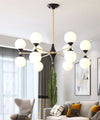
- Radiating multi-arm forms, where several rods or stems fan out from a central point.
- Globe and dome shades in glass or metal, often set at an angle rather than pointing straight down.
- Warm metal finishes: brushed brass, aged gold, or matte black, used on their own or paired together.
- Opal or frosted glass that softens the bulb into a warm glow instead of a harsh point of light.
- Bulbs that are either gently exposed or diffused just enough to stay visible as part of the design.
Done well, this reads current rather than retro. The restraint in the shapes and the warm, neutral palette happen to match where a lot of interiors are heading right now: less clutter, more natural material, softer light. A mid century fixture does not need a themed room around it to make sense. It just needs good bones.
Spotting good design (without the designer price tag)
You do not need a famous name to find a well made fixture. You need to look at the same things a trained eye looks at.
Start with proportion. A chandelier or pendant should feel balanced from the front, the side, and straight underneath, not just from the marketing photo angle. If the arms or shade look thin and flimsy from one view, that is a sign of a shortcut somewhere in production.
Materials matter more than most shoppers expect. Metal and glass age well: brass develops a soft patina, glass stays clear or takes on a gentle warmth from years of use. Plastic shades and painted plastic "metal" finishes tend to dull, yellow, or chip within a couple of years. Run your hand over the finish in photos or in person if you can. A good matte black or brushed brass finish should look even, with no visible brush marks, drips, or thin spots.
Check the silhouette from every angle you can see in the product photos. A well designed fixture stays interesting whether you are looking at it head on or from below, which matters most for chandeliers and pendants that hang in open sightlines.
Finally, read the fine print before you buy. Confirm what is actually included: bulbs, a downrod for extra drop height, the canopy that covers the ceiling mount, and any dimmer compatibility. Compare the fixture's listed width, height, and canopy size against your space rather than guessing from the photo alone.
The right mid century piece for each room
Mid century modern lighting works best when the fixture matches the scale and function of the room it is in.
| Room | Best fixture type | Placement guidance |
|---|---|---|
| Dining room | Radiating multi-arm chandelier | Hang 30 to 36 inches above the tabletop, centered over the table. |
| Entryway or kitchen island | Globe or dome pendant, single or in a row | Allow at least 7 feet of clearance from the floor in walkways. |
| Living room, beside a sofa | Arc floor lamp or tripod floor lamp | Position so the shade sits just above eye level when seated. |
| Bedroom or sideboard | Compact table lamp with a globe or dome shade | Choose a base height that keeps the shade below eye level at the nightstand. |
Open concept spaces can usually handle one larger statement piece, like a wide radiating chandelier over a dining or living area, as long as there is that 7 foot clearance below it for anyone walking through.
Mixing mid century lighting with current interiors
The easiest way to date a room is to build it entirely around one decade. Mid century modern lighting works best as an accent, not a full theme.
Pick one statement fixture per room. A radiating chandelier over the dining table or a sculptural floor lamp beside the sofa is enough to set the tone. Adding two or three more "matching" pieces in the same room usually tips it into a period set rather than a lived in home.
Echo the fixture's metal in small doses elsewhere: a brass drawer pull, a black picture frame, a gold vase. This ties the room together without forcing every surface to match.
Mid century pieces sit comfortably next to both modern and transitional furniture. A globe pendant looks just as at home over a simple modern dining table as it does next to a slightly more traditional buffet. What keeps it from clashing is restraint elsewhere in the room: plain walls, simple textiles, and furniture that is not overly ornate.
Keep bulbs warm, around 2700K, and use a filament style bulb wherever the bulb itself is visible, such as in an open globe or exposed socket fixture. That warm color temperature is doing a lot of the work in making the fixture feel inviting rather than clinical.
Shop mid century pieces from our collection
Two fixtures from our own catalog that carry the style honestly:

Draper Black Midcentury Chandelier from $676.39

Dieg Midcentury Chandelier from $755.71
Materials and bulbs that keep the look honest
Brass and matte black are the two finishes that carry most mid century modern lighting, and each does a different job. Brass warms up a room and pairs naturally with wood tones, cream, and deep green. Matte black reads a bit more current and works well in rooms that already lean toward a neutral or monochrome palette. Neither is more "correct" than the other, it depends on the room.
Opal glass diffuses light evenly and hides the bulb, which is useful over a dining table where you do not want a visible glare. Clear glass shows off the bulb itself, so it only works if you are using a bulb that looks good on display, like a filament style LED.
Speaking of which, LED filament bulbs are worth the small extra cost. They give you the warm, slightly textured glow of an old fashioned bulb without the heat output or the short lifespan, and most are rated for 15,000 hours or more.
If you upgrade one thing beyond the fixture itself, make it a dimmer switch. Mid century pieces were built for softer, more atmospheric light, and a dimmer lets one fixture do double duty as both a bright task light and a low, warm evening glow.
FAQ
Is mid century modern lighting still in style?
Yes. The style's warm metals, opal glass, and simple organic shapes fit naturally into today's preference for warm minimalism. Because it relies on proportion and material rather than heavy ornamentation, it does not read as dated the way more decorative period styles can.
What color light bulb is best for mid century fixtures?
Aim for 2700K, a warm white that matches the era's original incandescent glow. Anything above 3000K starts to look cool and clinical against brass or matte black finishes and opal glass, which were designed around a softer, warmer light.
Can I mix mid century lighting with a modern home?
Yes, and it usually looks better than a fully matched period room. Use one mid century fixture as a focal point, keep the surrounding furniture simple, and repeat its metal finish in a small accent or two elsewhere in the space.
If you want to see how these shapes and finishes look up close, browse our mid century collection for chandeliers, pendants, and lamps sized for real rooms, not just showroom photos. Every order ships free within the US, and our team is happy to help you double check sizing before you buy.
← Older Post Newer Post →